Uncategorized
The best coilovers for daily driving put comfort first, so we’d start with the KW V2 Comfort, or the KW V1 if you won’t touch an adjuster. That’s for anyone who has settled on coilovers and doesn’t want to regret it on the morning commute. Our page on suspension upgrades in San Marcos covers how HG Performance matches a system to the way you drive.
A daily driver needs the softest spring rate the maker matched to your car, paired with a damper built for the road. Spring rate means how stiff the spring is, and it sets how much of each bump reaches your seat. Stiffer isn’t better on the street, because a firm spring skips over rough pavement instead of soaking it up.
There’s no single number to ask for. A heavy EV needs a far stiffer spring than a light hatchback, so don’t copy a rate from a forum post about another car.
The damper, the shock inside the coilover, matters just as much for ride comfort. A good one settles the car after a bump, and a poor one lets it keep bouncing. That’s why street coilovers from a good maker can feel calm on a road where a cheap kit with similar springs feels harsh.
If you’re shopping because the car already feels harsh or bouncy, get it checked before you buy anything. Worn shocks or mounts can cause that, and our suspension service and repair may fix it for less than a new kit.
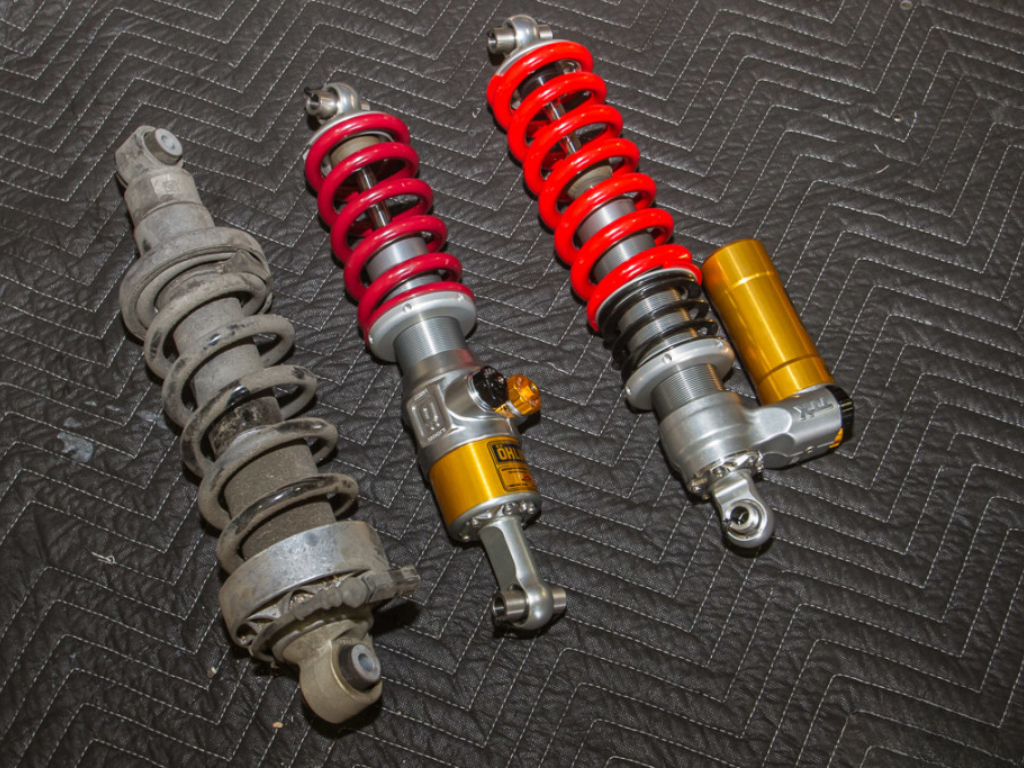
One adjuster is enough for a daily driver, and none is fine if you’d set the car once and leave it. Damping adjustment changes how the shock resists movement, and it has two parts. Rebound is the wheel coming back down after a bump, and compression is the wheel moving up into it.
A single adjustable kit gives you one control, and a double adjustable kit sets the two separately. Rebound is the one you’ll feel on a commute, so one control covers what you need. Compression earns its keep when you drive hard on a good road.
Don’t pay for clicks you won’t use. More settings won’t give you a better ride, and two adjusters make it easier to end up worse than where the kit started. Ask where the adjuster sits on your car too, because if it’s awkward to reach, you’ll set it once and forget it.
KW V1 and V2 are both strong options for street use. We’d start with the V2 Comfort when everyday comfort is the priority, or the V1 for a driver who wants a setup without damping adjustment.
| KW kit | What you adjust | Who it suits | Our call |
| V1 | Height only | Set it once and drive | Pick it if you won’t touch an adjuster |
| V2 Comfort | Height and rebound | Comfort first, moderate drop | Our first choice |
| V2 | Height and rebound | Sportier feel, more drop | Pick it if new wheels need the lower range |
| V3 | Height, rebound and compression | More aggressive setups and drivers who want tuning flexibility | Consider it when the setup calls for more adjustment |
KW V3 and Clubsport are options we’d consider for more aggressive setups. That doesn’t rule out the V3 for a street-driven car: our BMW F80 M3 build used KW V3 coilovers with an EDC delete. The right choice depends on the car, the intended use and how much adjustment the driver wants.
Our KW suspension page uses the older Variant names, and Variant 1 is the same kit as the V1.
KW V1 and V2 are strong street-use options, while Bilstein and Öhlins are also worth considering for the right car. Between Bilstein and Öhlins, our preference at HG Performance is Öhlins, but the recommendation depends on the vehicle and the driver’s priorities. The Bilstein B14 offers a setup with no damping adjustment, while the B16 adds an adjuster.
Öhlins Road & Track kits are worth it if Öhlins makes one for your car and you want dampers that can be rebuilt later. Expect a small height range on some of them.
Warranty is where they split. KW backs the kits in that table with a limited lifetime warranty and no mileage limit. Bilstein gives the B14 and B16 five years, and Öhlins lists two years on its Road & Track kits.
Read the limits as well. Bilstein’s warranty excludes ride quality, so it won’t help if you dislike the feel, and it excludes bad installation. That’s why getting the choice right matters more than the warranty length.
A daily driver should sit at a modest drop, well short of the bottom of the kit’s ride height range. The lower you go, the less room the spring and shock have to work, and that’s where a comfortable kit starts to feel crashy.
Check the top of the range as well. Some kits sit lower than stock even at their highest setting, so you may not be able to raise the car back for a steep driveway. If one driveway is the whole problem, ask about KW’s HLS, a lift system available on some cars that raises the car on demand.
Mind the legal limit too. California Vehicle Code 24400 sets a 22-inch minimum for headlight height, so a car with low-set lights has less room to give.
Buying on price is the mistake we’d stop you from making. Budget kits often pair springs that are too stiff with dampers that can’t control them, so the ride gets harsh and bouncy. Seals can leak and height collars can seize, and then you’re paying twice. If a good kit is out of reach this year, we’d fit quality lowering springs before a cheap coilover.
Don’t ignore the top mounts, the parts that join each strut to the body. Some kits reuse the originals and some don’t, and tired mounts can clunk on brand-new coilovers. Have them checked while the suspension is apart, because that’s when it’s easy to replace them.
Check for electronic dampers before you order. If your drive modes change the suspension, coilovers take those dampers off, so you’ll usually need a delete kit too. Our BMW F80 M3 build paired KW V3 coilovers with an EDC delete.
Plan the install and alignment as one job. Let the car settle, set the final height, then align it, because changing the height afterwards throws the alignment off and wears the inside edge of your tires.
Your car decides it first, because kits and spring rates are built per model, and not every kit exists for every car. After that, it’s your wheels and tires, your roads and how much you’ll adjust.
To give you an answer for your car, we’d need your year, make, model and mileage, plus your wheel and tire sizes. Tell us whether the suspension has drive modes and how often you’d touch an adjuster. Send that through our contact form and we’ll talk through the options your car allows.
For daily street use, KW V1 and V2 are strong starting points. We’d consider V3 or Clubsport for a more aggressive setup, and our preference between Bilstein and Öhlins is Öhlins when it suits the car. To recommend a kit, we’d need your year, make and model, your wheels and the roads you drive.
HG Performance is Master ASE Certified, has been in operation since 1969 and has served North County San Diego from 182 Pawnee St since 2018, on all makes and models. Get a consultation before you order a kit.
A good street kit can get close, and on a car with worn factory shocks it can ride better. You’ll still feel more of the road, especially on low-profile tires. HG Performance would start at the soft end of the damping and firm it up only if the car feels loose.
They can. A firm kit passes more road noise into the cabin. A clunk after install usually points to something loose or worn, such as a lock collar, top mount or end link. HG Performance would check the fitment first, because a new clunk shouldn’t be left alone.
We wouldn’t on a daily driver. KW and Bilstein tie their warranties to the original buyer, so you’d have no cover, and you can’t see how worn a damper is from the outside. A used kit may not suit your exact car either, so ask HG Performance before you buy one.
We’d consider Öhlins and Bilstein, with Öhlins our preference between the two when it suits the vehicle. Availability and the right setup depend on the make, model and year. HG Performance works on Asian, American, European and exotic cars and SUVs, so tell us what you drive and we’ll go through the options.

HG Performance provides auto repair, maintenance, diagnostics, and select performance upgrades for cars and SUVs of all makes and models in San Marcos, CA.
© 2026 HG Performance by Blync.io